
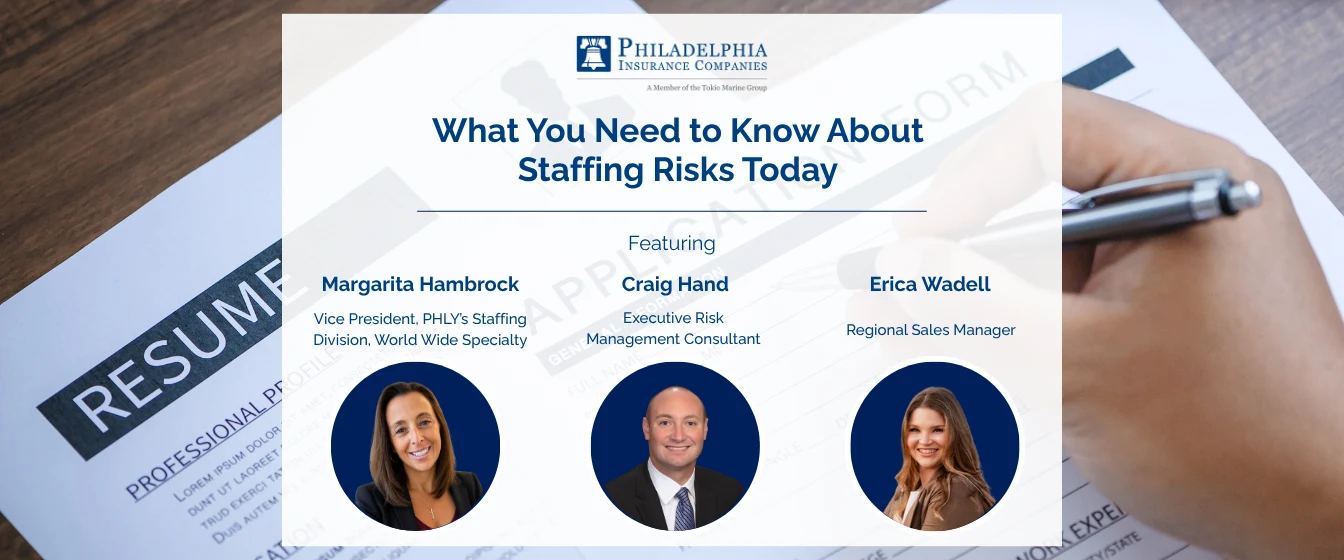
What separates a well-protected staffing firm from one facing an unexpected six-figure claim? Often, it's understanding the risks before they become losses. With staffing industry revenue expected to grow 3% in 2026, many firms are looking to expand. This makes it more important than ever for insurance agents to recommend the right staffing insurance solutions and help clients strengthen their risk management practices.
In a recent LinkedIn Live discussion hosted by Philadelphia Insurance Companies (PHLY), moderator and PHLY Regional Sales Manager Erica Waddell sat down with Margarita Hambrock, Vice President of the Staffing Division at World Wide Specialty, and Craig Hand, Executive Risk Management Consultant at PHLY, to discuss the trends, claims, and underwriting considerations shaping today's staffing industry.
How the Staffing Insurance Market Has Evolved
To understand today's staffing risks, it helps to understand how the industry - and the insurance designed to protect it - has evolved.
"In the 1960s, the staffing industry identified a major insurance coverage gap after firms experienced uncovered losses under what was then their standard general liability policies," says Hambrock.
One notable claim involving a temporary employee who falsified education credentials highlighted the need for specialized protection beyond traditional liability coverage. It ultimately led to the development of errors and omissions (E&O) insurance.
An important component of today’s staffing liability insurance, E&O insurance was created by Eileen Lesberg, whom Hambrock describes as “a pioneer in her time.” That innovation laid the foundation for specialized coverage tailored to the industry’s unique risks. Lesberg later founded World Wide Specialty (WWS), which became a leader in insurance products for staffing agencies. In December of 2020, WWS joined PHLY, combining decades of staffing expertise with the resources of a national specialty insurer.

PHLY's Appetite for Staffing Risks
While the staffing industry has evolved significantly over the years, so has PHLY's approach to underwriting. Today, PHLY writes staffing insurance solutions and temp staffing insurance for a broad range of temporary staffing organizations, including:
Healthcare (established)
Professional placements
Construction
Light and heavy industrial placements
Higher-hazard operations, including startup healthcare staffing, oil and gas, mining, transportation, emergency response, and placements involving children, require additional underwriting review. Rather than assuming a risk falls inside or outside PHLY's appetite, Hambrock encourages insurance agents to start the conversation. "Please just pick up the phone, call us, ask us... We've been in the industry a very long time, so we've seen it."
Protection from Job Description Drift
One of today's most significant staffing firm business risks is job description drift. This is when a temporary employee is assigned duties that differ from those originally agreed upon by the staffing agency and client.
Unfortunately, this type of claim is more common than expected. Hambrock shares the example of a temporary employee hired to perform routine warehouse picking and packing duties who was later asked to operate a crane after another employee called in sick. Because the worker had not been trained or authorized for that role, the incident resulted in nearly $700,000 in property damage and bodily injury claims.
According to Hambrock, the real issue wasn't simply the accident itself; it was the breakdown in communication and controls that allowed a low-hazard assignment to become a high-severity exposure without the staffing agency's knowledge. To help reduce risk, she encourages agencies to require prior approval for job-duty changes and to avoid broad contract language such as "other duties as assigned."
Why Higher Limits Aren't Always Better
Staffing agencies often feel pressure to increase liability limits to satisfy client contracts or win new business. However, Hambrock explains that higher limits can also make an organization a more attractive litigation target in today's social inflation environment.
"Limits don't just protect against loss. They actively influence claim severity," she says, noting that plaintiff attorneys often consider available policy limits when determining settlement demands and litigation strategy.
Rather than automatically recommending higher limits, insurance agents should help staffing clients balance contractual requirements with their actual exposure and long-term risk management goals. (Learn why PHLY takes a disciplined approach to policy limits by watching the full LinkedIn Live discussion.)
Managing Hired and Non-Owned Auto Risk
Craig Hand, Executive Risk Management Consultant at PHLY, shifts the conversation from underwriting to practical staffing risk management strategies, beginning with one of the most commonly overlooked exposures: hired and non-owned auto coverage. As he explains, even staffing agencies that don't own company vehicles can face liability when employees drive personal, rental or client’s vehicles while performing work-related duties.
Hand recommends several practical steps to help reduce risk:
Run annual motor vehicle record (MVR) checks for employees who drive on company business.
Encourage higher personal auto liability limits whenever possible.
Establish written driver safety policies.
Provide defensive driving and distracted driving training.
"Just because staffing companies may not own autos, it certainly doesn't exclude them from the hired, non owned exposure," he says.
These proactive staffing risk management practices can help reduce claims while demonstrating a strong commitment to safety. Hand also shares additional recommendations and real-world examples during the full LinkedIn Live discussion.
Staffing Risk Management Resources for Insurance Agents
In addition to identifying risks, Hand emphasizes the importance of giving staffing firms the tools to help prevent them. PHLY policyholders have access to PHLYGateway, a comprehensive online resource that supports staffing risk management through training, employment practices guidance, and practical compliance tools.
For agencies reviewing staffing contracts, Hambrock also recommends using the American Staffing Association (ASA) model contracts as a starting point, while noting that PHLY's underwriting and risk management teams are always available to discuss individual accounts and help agents navigate unique exposures.
Why This Matters for Insurance Agents
Today's staffing firms face risks that require specialized knowledge and proactive planning. Insurance agents who understand these challenges can help clients make more informed coverage decisions while strengthening long-term risk management.
Watch the full LinkedIn Live recording to hear the complete discussion, including audience questions, more real-world claims examples, and expert guidance.
To learn more about PHLY's insurance for temp staffing agencies, view the Temporary Staffing product page, explore the current underwriting appetite, call 1-800-873-4552, or contact the staffing team to discuss your clients' unique risks.