The average person takes 18,000 steps every day, but how many of these steps are taken seriously? There are over 13 million slip, trip and fall injuries every year that can result in lost workdays, broken bones, "bad backs", even permanent disability and death.
According to OSHA, slip, trip and fall injuries account for 100,000 lost-workday accidents every year and an average of 130 deaths.
SLIPS a loss of balance caused by too little friction between an individual’s feet and the surface he/she works or walks on.
TRIPS a loss of balance caused by interference between forward motion and an object.
FALLS a result of when an individual moves too far off his/her center of balance.
The most common causes of slips are constantly wet surfaces from spills or weather hazards. If you must walk on wet surfaces, prevent slip injuries by taking a few simple precautions. Take short steps, walk with your feet pointed outward slightly, make wide turns at corners, slow down, especially at intersections and wear slip-resistant shoes appropriate for your job. Whenever you see a spill, clean it up right away or mark the spill with a sign, paper towels, or wastebasket, and report it to the appropriate person in your work area. Trips most often occur when you try to take a short cut. Like slips and falls, trips are more likely when you are in a hurry and do not pay attention to where you are going.
 As an employer, you and your employees should commit yourselves to preventing slip, trip and fall incidents, and keep the workplace as safe and accident free as possible. As an employer, you and your employees should commit yourselves to preventing slip, trip and fall incidents, and keep the workplace as safe and accident free as possible.
Be Prepared – Develop a Plan
- RECOGNIZE the hazards on the job. Pay attention and make sure you can see the path ahead.
- AVOID hazards by walking around them carefully or stepping over them. Be sure to slow down so you can keep your balance.
- CONTROL hazards by marking them clearly so others won't get hurt. Then fix the hazard yourself or report it right away.
Additional Tips
Be cautious - take the pathway provided for pedestrians. Slow down and only carry loads you can see over.
Always turn on lights before going into a room. Replace burned out light bulbs immediately. Repair fixtures and cords immediately if they malfunction. Move slowly where the light is dim. Keep work areas clean and free of clutter, especially in storage rooms and walkways.
Inadequate equipment for a job is the most common cause of falls. As with slips and trips, hurrying and being distracted often contribute to a fall.
Use appropriate equipment - make sure you have the right climbing equipment for the job. Once you have the right equipment for the job, don't overreach.
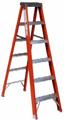 Improper ladder usage is a major source of fall related accidents. According to the Consumer Product Safety Commission, there are over 90,000 emergency room visits annually relating to ladder accidents. These accidents can be eliminated by obtaining the correct ladder for the application and employee training. Follow the 1 to 4 rule when using a straight/extension ladder: set the base out from its support one foot for every four feet of working ladder height. (Measure "working height" from the ground to where the ladder hits its support.) Have someone hold the base and/or tie off the ladder securely. Set the ladder on firm, stable ground. When the ladder is being used for employee transfer to another walking surface, the extension ladder should extend three feet beyond its contact with the building and be secured at the top to help prevent accidental displacement. Never use the top rung and always inspect a ladder before using it. Never carry materials while climbing or descending a ladder. Materials should be raised and lowered with a tether. Always adhere to the manufacturer’s safe use instructions. Improper ladder usage is a major source of fall related accidents. According to the Consumer Product Safety Commission, there are over 90,000 emergency room visits annually relating to ladder accidents. These accidents can be eliminated by obtaining the correct ladder for the application and employee training. Follow the 1 to 4 rule when using a straight/extension ladder: set the base out from its support one foot for every four feet of working ladder height. (Measure "working height" from the ground to where the ladder hits its support.) Have someone hold the base and/or tie off the ladder securely. Set the ladder on firm, stable ground. When the ladder is being used for employee transfer to another walking surface, the extension ladder should extend three feet beyond its contact with the building and be secured at the top to help prevent accidental displacement. Never use the top rung and always inspect a ladder before using it. Never carry materials while climbing or descending a ladder. Materials should be raised and lowered with a tether. Always adhere to the manufacturer’s safe use instructions.
Additional Protection and Prevention
Floor Cleaning Procedures: Steps for General Floor Cleaning
Formal Housekeeping Program: Steps for Housekeeping Program
Technical Bulletin: Fall Protection Guards and Handrails
Incident Report Form: Slip and Fall Incident Report Form
For more information about slips, trips and falls prevention, please visit our website at www.losscontrol.com
Additional resources include:
OSHA’s Guide to Stairways and Ladders
Stairways and Ladders - A Guide to OSHA Rules, OSHA Publication 3124 2003
OSHA's Housekeeping Regulation
29 CFR 1910.22(a)
National Ag Saftey Database
Preventing Injuries from Slips Trips and Falls
Iowa State University
PowerPoint Presentation on Housekeeping and Fire Safety
OSHA
Walking-Working Surfaces (Slips Trips and Falls)
|
Contact Information
|
|
HOME OFFICE CONTACTS
|
|
Mark Konchan, ARM CSP
Vice President
Home Office – Bala Cynwyd, PA
Phone: (800) 873-4552
E-Mail: mkonchan@phlyins.com
Bill Mesure, Sr. Loss Control Consultant
(Mid-Atlantic Region)
Home Office – Bala Cynwyd, PA
Phone: (800) 873-4552
E-Mail: bmesure@phlyins.com |
|
REGIONAL OFFICE CONTACTS
|
|
Leslie Dugan, Assistant Vice President
(Sunbelt, Western, Northwest,
Rocky Mountain Regions)
Mission Viejo, CA
Phone: (800) 994-4121 ext. 236
E-Mail: ldugan@phlyins.com
Thomas Merritt, Loss Control Consultant
(Sunbelt, Western, Northwest Regions)
Mission Viejo, CA
Phone: (800) 994-4121 ext. 223
E-Mail: tmerritt@phlyins.com
Kenneth R Zimmerman, CSP
Regional Loss Control Manager
(Rocky Mountain)
Littleton, CO 80127
Phone: (866) 608.5898 ext. 5351
E-Mail: kzimmerman@phlyins.com
Brett Hines, Regional Loss Control Manager
(Central, Southwest Regions)
Independence, MO
Phone: (877) 439-7459
E-Mail: bhines@phlyins.com
Ron Quattrochi, Regional Loss Control Manager
(Northeast Region)
Stoughton, MA
Phone: (888) 292-3881 ext. 268
E-Mail: rquattrochi@phlyins.com
Scott Holt, Sr. Loss Control Consultant
(Metro Region)
Lawrenceville, NJ
Phone: (866) 586-6122 ext. 264
E-Mail: sholt@phlyins.com
George Kalule, Loss Control Consultant
(North Central Region)
Naperville, IL
Phone: (800) 547-9967 ext. 2256
E-Mail: gkalule@phlyins.com
Philip Azar, Sr. Loss Control Consultant
(Southeast, Florida Regions)
Kennesaw, GA
Phone:(770) 799-3067
E-Mail: pazar@phlyins.com
Rachael Marchini, Sr. Loss Control Consultant
(Ohio Valley Region)
Beachwood, OH
Phone: (866) 295-3042
E-Mail: rmarchini@phlyins.com
|
IMPORTANT NOTICE - The information and suggestions presented by Philadelphia
Indemnity Insurance Company in this E-Brochure is for your consideration in your loss prevention efforts.
They are not intended to be complete or definitive in identifying all hazards associated with your business,
preventing workplace accidents, or complying with any safety related, or other, laws or regulations. You are
encouraged to alter them to fit the specific hazards of your business and to have your legal counsel review
all of your plans and company policies.
|
|





 As an employer, you and your employees should commit yourselves to preventing slip, trip and fall incidents, and keep the workplace as safe and accident free as possible.
  Improper ladder usage is a major source of fall related accidents. According to the Consumer Product Safety Commission, there are over 90,000 emergency room visits annually relating to ladder accidents. These accidents can be eliminated by obtaining the correct ladder for the application and employee training. Follow the 1 to 4 rule when using a straight/extension ladder: set the base out from its support one foot for every four feet of working ladder height. (Measure "working height" from the ground to where the ladder hits its support.) Have someone hold the base and/or tie off the ladder securely. Set the ladder on firm, stable ground. When the ladder is being used for employee transfer to another walking surface, the extension ladder should extend three feet beyond its contact with the building and be secured at the top to help prevent accidental displacement. Never use the top rung and always inspect a ladder before using it. Never carry materials while climbing or descending a ladder. Materials should be raised and lowered with a tether. Always adhere to the manufacturer’s safe use instructions.